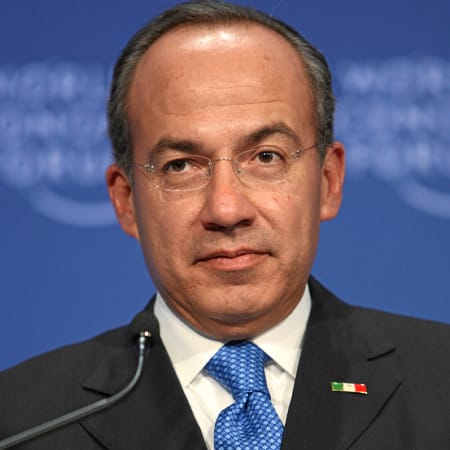
Felipe Calderónwas born in Morelia, in the central-west state of Michoacán, Mexico. He was was immersed in politics from a young age. His father, Luis Calderón Vega, was a founding member of the National Action Party (PAN), a political party rooted in conservative and Christian democratic principles. Growing up in such an environment, Felipe Calderón developed a keen interest in public service and politics, which would later shape his career.
The young Felipe was active in his father’s campaigns. As a boy, he distributed party pamphlets and flyers, rode PAN campaign vehicles and chanted slogans at rallies.
.
After growing up in Morelia, Felipe Calderón relocated to Mexico City to pursue higher education. He earned his law degree from the prestigious Escuela Libre de Derecho, which laid the foundation for his future in public service. Felipe then deepened his expertise by obtaining a master’s degree in economics from the Instituto Tecnológico Autónomo de México (ITAM), equipping him with the analytical tools to navigate complex economic challenges.
In 2000, he further enhanced his academic credentials by completing a Master of Public Administration at Harvard University’s John F. Kennedy School of Government, solidifying his global perspective on governance and leadership.
.
Felipe Calderón | Early Political Career
His early political career saw him leading the PAN’s youth wing, where he honed his leadership skills and established himself as a rising star within the party. From 1991 to 1994, he served as a federal deputy, representing the party in Mexico’s Chamber of Deputies. In 1993, under the guidance of his political mentor, Carlos Castillo Peraza, who had just taken over as PAN president, Felipe was appointed the party’s secretary-general. When Castillo Peraza stepped down in 1996, Felipe succeeded him as the president of PAN, a role he held until 1999, during which he played a key role in shaping the party’s direction.
.
Felipe Calderón | Domestic Policies
Going into office, Felipe Calderón had made many pledges to the electorate. He created 96 new universities, the largest number in the history of Mexico. He granted full coverage and a secure spot in elementary schools to children from 6 to 11 years old, the only president to have done this. He created The Office of Social Aid for Victims of Violence. During his tenure, he created more than 1,000 hospitals, and more than 2,000 were reconstructed and amplified. Felipe created more than 16,500 kilometres of interstate highways.
.
One of Felipe Calderón’s most defining and controversial initiatives was his aggressive stance against Mexico’s drug cartels. Shortly after taking office, he launched a full-scale military offensive against organized crime, deploying thousands of troops across the country. His administration aimed to dismantle the powerful cartels that had infiltrated Mexican society and contributed to escalating violence and corruption.
.
Felipe Calderón |Speaking Topics
Felipe is a highly regarded global speaker sought after for his insights on a wide range of topics, including economic development, political leadership, and environmental sustainability. His ability to draw from his experience as a head of state and his deep knowledge of economics, public policy and sustainability makes him a valuable voice in discussions on global challenges.
– Leadership
– Sustainability / Sustainable Development
– Climate Change
– Creating Economic Opportunities by Improving the Climate
– Economy & Politics
– Crisis and Competitiveness
.
To check fees and availability for Climate Change Speaker Filipe Calderón, contact Great Business Speakers on 0044 (0)1753 439289